
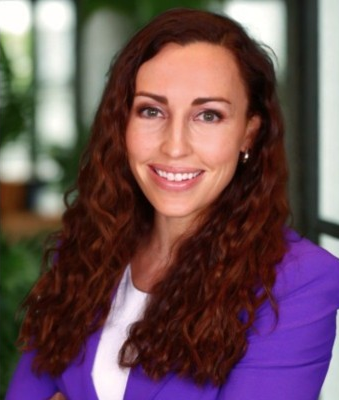
Jessica Willoughby is the fractional COO of mQOL, a patient engagement platform, and a member of business networks like CHIEF, Forbes Business Council, and Women Business Leaders. Mission-driven and passionate about sustainable growth, she helps organizations scale with people always at top of mind.
Willoughby strives to equip women in healthcare tech who want to earn their seat at every table while opening doors for up-and-coming leaders—whether through targeted mentorship, sponsorship, or advocacy. During our conversation, she explores how her community created a space for her to learn without judgment, and why she continues to carry the torch for others.
Shiwon Oh: You provide clarity and direction to health tech clients that want to grow. How do you best equip up-and-coming organizations for sustainable, people-centered scaling?
Jessica Willoughby: Sustainable scaling starts with being honest about what an organization needs at its current stage, rather than building for the company it hopes to become five years from now. Every organization is different, so I draw from what I have learned across other startups without walking in with a predetermined playbook. I begin by understanding the organization in front of me: how the teams function, how people communicate, who owns what, and where the founder or CEO feels the most pressure.
During my first few weeks, I listen as much as possible. I start with a deep dive with the founder and then meet individually with members of the executive and leadership teams. I join calls, observe how decisions are made and ask a lot of questions about how people and processes fit together. I usually warn teams that questions are how I learn because I never want genuine curiosity to feel like I am evaluating someone’s competency. I am building a context map in my head so I can understand the company before recommending where it should go.
Earlier in my career, my instinct was to jump in and show progress right away. Experience has taught me that some of the most valuable work happens before the first project plan is created. When you take time to observe, you often discover capabilities the organization has not fully recognized. An ambitious entry-level employee who is curious about how all the pieces fit together, for example, may have the potential to grow into a project management or operations role with the right support.
Once I understand the people and the organization, I can help create clarity around the mission, immediate priorities and who owns what. To me, people-centered scaling means building with the strengths already present on the team, creating opportunities for people to grow and designing processes around how work actually gets done. It also means making sure employees understand how their roles contribute to the larger goals, rather than simply adding more systems, positions or layers as the company expands.
In health tech, people-centered scaling must also include the patient, clinician and employee experience. A technology may be impressive, but if it does not fit into a clinical workflow or solve a problem people genuinely have, it becomes another tool no one wants to use. Sustainable growth happens when the operating model, financial realities and human experience evolve together.
SO: What are/were some of the most rewarding aspects of your career, especially in an industry so close and personal to many?
JW: The most rewarding parts of my career fall into two categories for me: the people I have helped grow and the patients whose lives were affected by something I helped build.
As a leader, I have spent countless hours behind the scenes helping mentees and direct reports prepare for an important meeting or presentation. In many cases, I could have presented the information myself, and honestly, it probably would have been faster. But if I take the time to help someone build the skills and confidence to present it, we now have one more capable person with a voice at the table.
I think this is something leaders can miss. It is not enough to create a seat at the table and tell someone to sit in it. Emerging leaders may also need preparation, honest feedback and someone reminding them that they belong there. Watching someone find their voice and realize what they are capable of has been one of the most rewarding parts of my career.
The second category is the impact my work has had on patients. At Anthem, I helped build and scale an AI-powered symptom-triage application that launched in January 2020. We expected a few thousand users during the initial rollout. Then COVID changed everything. Demand grew to more than 250,000 users a month, and we worked quickly to connect people with physicians, testing resources and eventually vaccine sites.
As the pandemic continued, we began receiving messages from the people using the application. Parents were trying to get medication for a child’s ear infection without taking the entire family into a medical office. Caregivers of people with compromised immune systems needed help with their own symptoms but were afraid of bringing COVID home. Other patients thanked us for directing them to testing sites and confirming that what they were experiencing needed medical attention.
One of those moments hit especially close to home. My youngest sister was working at a coffee shop during the pandemic. She and her coworkers were considered frontline workers, but they could not always step away during a shift to call a doctor. When one of her coworkers became sick, I was able to recommend the application. She could complete the symptom triage on her own time and communicate with a physician by text throughout her shift.
This was the first time in my career that I heard directly from patients about how something I helped build had changed their lives for the better. After that, I could not go back. It is why I continue to choose mission-driven healthcare companies and work where I can see a real connection between what we are building and the people it is meant to help.
SO: How have your different communities—Chief, WBL, Forbes Business Council—elevated your leadership?
JW: When I attended my first in-person Chief event, I was terrified. I had no idea a space like that could exist, let alone that it already did. It felt like someone had taken my most supportive and competent friend, added even more work experience and filled an entire room with women who were on my side and wanted me to succeed.
Chief and WBL both pushed me outside my comfort zone, but they did it in a space where I felt safe asking questions and admitting when I did not have an answer. They also helped me find my voice as I was starting my own business. I had an idea in my head, almost like a hypothesis, about what I could offer mission-driven companies. Through dozens of conversations with women in these communities, I became better at explaining what I do well, where I create value and what I wanted my business to become. The vision became sharper with every conversation, and I felt much less alone while figuring it out.
WBL also connected me with women who understand the specific opportunities and challenges within healthcare. One lesson that has stayed with me is that there is no such thing as a cold call, only a warm discussion. I also learned to have my ask ready, while being equally prepared to ask how I could help the other person. That made networking feel less transactional and much more like building a real community.
Forbes Business Council has given me another way to strengthen my voice by putting my ideas into writing and contributing to larger conversations about leadership, healthcare and business. Writing has a way of showing you whether you really understand what you believe. Together, these communities have given me a place to test ideas, learn from other women and grow into my own definition of leadership.
SO: How does your circle of mentors, mentees, sponsors, and colleagues empower you to pour into others walking similar journeys?
JW: It is not an exaggeration to say I would not be here today without my mom. Besides the obvious birthing-me part, I grew up watching her build a successful career in a male-dominated field without a college degree. She taught me a great deal about hard work and perseverance, but one of her greatest influences on me came from the way she opened doors for other people.
As I neared the end of college, my mom was at a social gathering where a friend offered a marketing internship to someone else’s daughter. When that conversation did not go anywhere, my mom jumped in and suggested that her friend speak with me because marketing was, in fact, my major. I was not part of that conversation, but my mom said my name and opened my first door into the corporate world. She showed me what it means to advocate for someone who is not in the room and make sure they know an opportunity exists. That was my first experience with what I now call my “no gatekeeping” policy.
My manager during that internship took me under her wing and taught me how to navigate the job, office politics, and time management. Throughout my career, my mom has provided guidance from interview preparation to talking through everything from traveling with male colleagues to client dress codes and annual reviews. I learned early how much it matters to have women who will share what they know instead of expecting you to figure everything out alone.
I experienced that kind of support again in my first healthcare role at TriZetto. I joined a new team led by one of the company’s rising stars, Dana, and her right hand, Linda. They poured their time, energy and expertise into me and another woman who had joined before the official campus recruiting program began. Linda spent hours teaching us about healthcare systems and billing. Both women made sure we understood not only what we were doing, but why it mattered and how all the pieces fit together.
Dana and Linda also brought us into their network. Each person they introduced us to explained another part of the business, and because the introduction came from leaders they respected, we became part of that trusted circle too. They advocated for us to attend trainings, travel to client sites, and observe real client meetings. I learned by watching how they handled difficult conversations with colleagues, clients and executives. Most importantly, they created an environment where I felt safe asking questions, raising concerns and finding my own voice.
I had taken what felt like the biggest risk of my career by paying to buy out my contract with my previous employer so I could start at TriZetto two months early. That decision moved my career forward by at least five years, due in no small part to Dana, Linda and the network of incredible women around them. When an organizational change later moved me into a different reporting structure, I began to understand how rare and valuable that support had been.
I have tried to carry those lessons into the way I lead and mentor. It may take longer to sit with someone and help them work through a problem, but you are helping them develop a skill they can carry forward. I bring people into my network so they do not feel as though they are starting from scratch. I cannot pour my soul into everyone, as much as I might like to, so I focus on a few deeper mentoring relationships while continuing to share opportunities and make connections. I also rely on my own friends, peers, mentors and advisors to challenge me and refill my cup. It has to be reciprocal.
After all, life is not a Colorado hiking trail. There is no benefit to making someone fight through the poison ivy when you can point them toward an already worn path. As I move forward, I want to keep reaching back, pulling other people with me and showing them the way.
SO: As trends come and go, and we adapt to new technology regularly, how can leaders stay committed to excellence without compromising empathy?
JW: I do not think leaders can stay committed to excellence in healthcare without empathy. Excellence is not only having the newest technology or collecting more data. It also means understanding what a patient and the people who love them are experiencing, especially when they are frightened, exhausted and trying to make decisions they never expected to face.
I learned this when my father was hit by a car while cycling. He survived surgery, but my family spent the next week in the ICU trying to piece together information from different clinicians and systems. We were scared, tired, and doing our best to understand what was happening. At the same time, I could tell that something about his cognitive state was not right, so I kept asking questions and requesting information.
Some of his records and scans were given to us on a CD-ROM, which was already outdated technology that many people no longer had a way to access. I persisted, read through information from multiple systems and eventually realized that he had suffered a concussion. Despite the force of his head breaking the windshield of the car, the concussion protocol had been missed.
His clinicians were working hard and individual pieces of technology were doing what they were designed to do. The problem was that the information was not connected. My family had to carry the full picture from one person and system to another while also managing the emotional toll of nearly losing someone we loved. That responsibility often falls to a family member, and very often to a woman, who becomes the advocate and unofficial keeper of the medical record during an already overwhelming experience.
That is why I constantly remind myself that there is a human being at the end of every healthcare interaction. There is also a family around that person trying to understand, help and advocate for them. Empathy means recognizing the weight they are carrying and building technology and processes that reduce that burden instead of adding to it.
As technology advances, true excellence will require more than innovation within one product or system. The technology has to work with the other systems involved in a person’s care, make important information accessible, and help clinicians see what they need to make informed decisions. It should also make room for patients and families to share what they are observing because they may hold context the data does not.
Technology will continue to change, but the standard should remain simple: does it help us care for people more completely? If it leaves patients frightened, families overwhelmed or critical information disconnected, it is not excellent healthcare, no matter how advanced the technology may be.
Join CCWomen+ today for more career success stories and executive community engagement.


.png?width=352&name=CCWomen%20Book%20Recs%20(3).png)